Friday, March 9, 2012

Grocery Wars on McKnight Road: Bottom Dollar Food vs. Giant Eagle’s Valu King

This should be interesting. Which store do you think is most likely to succeed, given their respective strategies as well as Pittsburgh demographics? Do you think they’ll both do well?

A simmering Pittsburgh grocery war may have just found its hottest battleground at Ross Towne Center and its neighboring retail properties on McKnight Road.

North Carolina-based Bottom Dollar has leased a former Goodwill location abutting the center for what may be its 13th store in the region. Right next door, in the former location of Roomful Express, ECHO Real Estate Services has leased 45,000 square feet to Giant Eagle , which may be planning to open the region’s first Valu King, a discount-oriented store concept that operates at a similar price point as Bottom Dollar, whose neighboring store will be 18,000 square feet.

Giant Eagle previously rolled out the Valu King concept in eastern Ohio and Erie, but has yet to bring it to its home market.

Herky Pollock, director of the retailer services group in the Pittsburgh office of CBRE, confirmed he represented the landlord for the former Goodwill store in reaching a deal with Bottom Dollar and that representatives of the neighboring former Roomful Express store, which is under a different owner, have told him of the plans for Valu King.

Officials for Bottom Dollar confirmed it will open a store in the McKnight Road location this fall. Dick Roberts, a spokesman for Giant Eagle, said there is “no confirmed plans for a location (for Valu King) in Pittsburgh yet.”

COMPETITION HEATING UP

But Pollock and other local real estate professionals have been notified that Giant Eagle, which operates a thriving store a short drive up McKnight Road at McIntyre Square, plans to bring Valu King to the former Roomful space.

Pollock views two discount grocery stores operating side by side in the same suburban shopping center as part of a larger outbreak in grocery competition in the Pittsburgh area, as long-dominant Giant Eagle faces an onslaught of new competitors entering the market.

That includes not just Bottom Dollar , owned by multibillion dollar Belgian conglomerate Delhaize , but also Fresh Market and Whole Foods , soon to open in Wexford, as well as Aldi and Trader Joe’s , which also are eyeing locations in the North Hills.

Kevin Dougherty, principal of North Carolina-based AdVenture Development and a Pittsburgh native, acknowledged he’s had talks with Trader Joe’s about establishing a store at his McCandless Crossing project further up McKnight Road.

He said it was only talk so far and expects Trader Joe’s is considering other locations as well in a Pittsburgh grocery market engaged in an ongoing chess match for the best locations.

“It sounds like people are repositioning and trying to give themselves the best competitive advantage,” he said.

“That would be good for the Pittsburgh market and the Pittsburgh consumer, that’s for sure.”

HEAD TO HEAD AND SIDE BY SIDE

It’s a rare circumstance to have grocery stores competing side by side, but where Ross Towne Center ends, other adjoining retail space with two other owners has made it possible. Often, Giant Eagle , in a common retail industry practice, sets up a store in a shopping center and establishes noncompete clauses to prohibit other stores from opening nearby, according to a number of retail real estate professionals, but this does not appear to be an option in this instance.

Craig Cozza, a developer with ample retail experience with retail leasing, noted it’s common for all retailers to seek noncompete clauses for the shopping centers they commit to and that grocery stores have more clout to exact such agreements since they are so coveted by landlords.

He said it’s possible Giant Eagle’s Valu King concept and Bottom Dollar could both thrive as neighbors.

There may be enough business there for both of them anyway,” he said.

Giant Eagle already has retooled its concept once before following the arrival of a competitor. When the region’s first Whole Foods opened in East Liberty a decade ago, Giant Eagle converted its Shadyside store a few blocks away into a Market District within a few years.

Giant Eagle has recently done the same in Pine, converting a Giant Eagle to Market District not far from where Whole Foods will soon open.

“For many, many years, Giant Eagle has maintained a dominant position in the region,” Pollock said. “Now that competition is coming in on the high and low end, they’re looking to shore up their dominance.”
Read more at bizjournals.com.

Friday, March 2, 2012

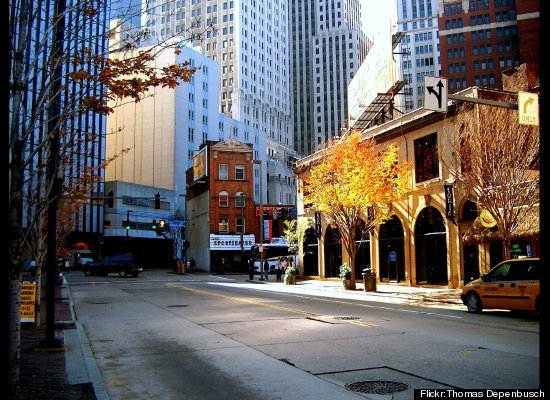
Why Pittsburgh Is A Hidden Travel Gem

If our city keeps getting great reviews like this, it won't be "hidden" much longer...

Pittsburgh might not be on your list of 1,000 places to fly to before you die, but perhaps it should be. With a cultural scene that rivals that of many larger cities, and its proximity to an architectural icon and a moving historical site that everyone should see before they head for the great beyond, this city of rivers and bridges deserves a visit. Plus, of course, now that Southwest Airlines and JetBlue fly here, airfares to Pittsburgh are amazingly cheap.


There's no place quite like Pittsburgh, an implausible and affable place of distinct and likeable neighborhoods, littered across a series of steep Southwestern Pennsylvania hills and secluded hollows, perched on cliffs and huddled down by its famed three rivers. Once at the forefront of the industrialized world, the still blue-collar city is shedding its old skin and growing into a new identity, as a knowledge center and a place of creativity.


That's not to say that Pittsburgh's gone pretentious or anything. This is still the home of the Steelers and the Pirates. Hate sports? No matter: This is still a great place to kick back and knock back a few (local) beers, make some new friends maybe; it's a perfect city for slowing down and just enjoying life for a couple of days. We've got eight great reasons to visit Pittsburgh (or, rather, da Burgh) right now.


Get in the Zone
There are plenty of cool neighborhoods in town, perhaps none quite as nifty as Lawrenceville. Located not far from downtown, this industrial center along the Allegheny River that served as arsenal to the Union Army during the Civil War is now a magnet for young creatives, lured in by a charming vibe. The neighborhood is part of the city's 16:62 Design Zone, an area that features more than 100 home decor-related businesses catering to all tastes and budgets. While in the area, stop in at Dozen, the neighborhood bakery that's the rage around town right now.


$10 Opera Tickets!
One thing a lot of first-timers don't know about Pittsburgh is that while the city isn't as big as it used to be, it still retains a vibrant cultural scene from its heyday. From ballet to world-class art museums, a marvelous symphony and a healthy theater scene, Pittsburgh has just about everything you could want a city to have, arts-wise, while, for the most part, keeping everything super accessible. Curious newbies can take advantage of $10 main floor tickets to the Pittsburgh Opera, home-based at the historic (and breathtaking) Benedum Center. And let's not forget the accomplished Pittsburgh Symphony Orchestra.


Good Eats
Pittsburgh has long been a town of simple tastes; for far too long, it seemed like the dining scene was content to hide out at least a couple of decades back from the present time. Recently, things have been changing, and rapidly; we're nuts for the ingredient-conscious, New American dinners at Eleven, the hardcore farm-to-table Legume Bistro in the North Oakland neighborhood* and the sleek look and feel -- not to mention the tasty American contemporary food and cocktails -- at the loungy Spoon in East Liberty. In short, you can eat really well here now, and not a moment too soon.


It's Near Frank Lloyd Wright's Fallingwater and the Flight 93 Memorial
Just an hour's drive or so from the city is one of the most iconic dwellings in the known Universe, the weekend home Wright designed for a wealthy Pittsburgh family. Some people come to PGH just as a jumping off point to visit, but of course there are many other great things to see and do here. (Tip: only the extended tour allows indoor photography, and it's well worth the $67 admission, although there are less expensive tours as well.) And speaking of nearby sites, the Flight 93 Memorial is also within driving distance, although the final phase is still under construction. It's a moving experience.


Try the Coffee
Pittsburgh is full of surprises; you probably didn't know it had a killer little café culture brewing, did you? From the locally-roasted liquid happiness at La Prima Espresso Bar (205 21st Street) to the sleek and sophisticated 21st Street Coffee down the block at #50 -- they use beans from Chicago's famous Intelligentsia -- to the cozy, sit down and stay awhile scene at Enrico's Tazza d'Oro in the heart of residential Highland Park (1125 N. Highland Ave.), coffee lovers are covered.


Play the Market
The city's Strip District is famous as the home of its wholesale markets, late-night gin joints and the obscene sandwiches at the terrific Primanti Brothers, but lately it's been showing signs of joining the 21st century. This fall saw the inauguration of the ambitious Pittsburgh Public Market, a Friday, Saturday and Sunday affair on Smallman Street between 16th and 17th Streets that showcases the region's bounty. A must-stop on any weekend visit.


Hit the Mattress
Pittsburgh is full of museums, some of them quite famous; if you visit just one, it should be the off-the-grid, awesomely unusual Mattress Factory. Tucked away in the back streets of the often-ignored North Side, artists have been creating installations in the space since the late 1970s. The museum offers a unique residency program, which allows the artists to live on site while dreaming up and then executing the installation or work of art. The museum is currently hosting an intriguing exhibit from the Lam Center of Contemporary Art in Havana, Cuba; the show deals with issues of race and racism in contemporary Cuban art.


Square Off
Speaking of mattresses, we're loving the sparkly, zen-like new Fairmont Hotel that's popped up right off Market Square in the heart of Pittsburgh's walkable downtown. A vast fitness center, a happening lobby bar and quiet, contemporary rooms, nearly all of them with great views (request one overlooking the skyline's crown jewel PPG Building), make this a great hotel just to waste a weekend in, never mind the city. We didn't try the restaurant, Habitat, on our two recent weekend visits but will next time.


Read more at the Huffington Post.

Monday, February 20, 2012

Checklist: what's needed in Pittsburgh neighborhood business districts

Business owners – this is like an open invitation to set up shop in one of Pittsburgh’s diverse neighborhoods. Take a look and see what residents in each neighborhood want the most.

Is a Thai restaurant the barometer of a hip neighborhood?  A greengrocer? Night life?  In the chess game that is business district management, some neighborhoods may appear to have all the pieces – but do they?  Pop City decided to survey various neighborhoods to see what's missing. Where there's a need, there's an opportunity. Calling all entrepreneurial types!

The Strip District “is only 12-25% retail,” says Becky Rodgers of Neighbors in the Strip.  “The rest is wholesale.  People thought they could just open in the [Pittsburgh Public] Market and make money.”  The reality is you need a good idea like Wigle Whiskey, a distiller recently opened on Smallman Street.  With stalwarts such as Penzey’s for spices and Labad’s for Middle Eastern, the Strip is set, right?  Not quite.

“We really want Indian food!” exclaims Rodgers.  “We get lots of national and international visitors as a first- or second-day destination in the region.”  The growing number of residents (Lot 24, a 97-unit rental development on Railroad Street, will soon break ground and plans call for new residential along the riverfront behind the produce terminal) means amenities including a dry cleaners and pharmacy are also needed.

In Lawrenceville, “our strength is a nice mix of convenience and destination businesses,” says Maya Henry of the Lawrenceville Corp.  Butler Street from 34th to 55th is a designated Main Street District and while the 30s tend toward trendy restaurants and apparel, the 40s are populated by convenience businesses including a cobbler, a pharmacist and French baker La Gourmandine. The 50s are still finding their raison d’etre.

A food gulch may develop in the latter now that Cure has opened across the street from Thai restaurant Pusadee’s Garden and close by where greengrocer Wild Purveyors will reside.  “We love to see clusters of apparel and restaurants,” says Henry.  “If one restaurant is busy, there’s another.  We also want people to make a Saturday of shopping our retail.”  What’s missing?  A grocery and hardware store.

East Carson Street on the South Side is the longest extant Victorian commercial district in the U.S. and a National Historic District.  “You can run every errand by foot – and it’s flat,” notes Aaron Sukenik of the South Side Local Development Co. “We have a dual economy, day and night.  There are thousands of employees in the district so we encourage retailers to stay open late.  Our nighttime activity is regional and national so when people visit Pittsburgh for games, they know to come here afterward.”

With the neighborhood’s demographic shifting from older adults to under 35, Sukenik wants an Indian restaurant along with more healthy/organic lunch options and a re-imagined butcher shop where people could order online and pick up later. A marina near the Hofbrauhaus in the permitting phase and will add even more cachĂ©.

In the 1940s and 50s, East Liberty was the third largest retail district in Pennsylvania (behind Philadelphia and Pittsburgh) thanks to the buying power of East Enders. The mall-ification of the 60s changed that and the neighborhood has been re-imagining itself since. “We’re striving toward mixed-income residential development,” says Skip Schwab of East Liberty Development Inc., “and we need amenities to do that.”  Wish fulfillment is coming in the way of the Ace Hotel, a 40-room boutique property in the old YMCA, and a digital theatre in the former PNC Bank building.  An REI store in Bakery Square would be icing on the cake.

The Penn-Garfield corridor is “the least expensive commercial district in the East End,” according to Rick Swartz of the Bloomfield-Garfield Corp. with buildings priced under $100,000. Now that the onetime working-class district is an emerging artist colony, the key is “a concerted effort to get kids to stay in the city.”

While the Pittsburgh Glass Center and Mr. Roboto Project pair nicely with graphics studios Ion Tank and Image Box, Swartz needs to see more housing for artists (“we need extended stays and youth hostels”) and a small grocery store “like a Bottom Dollar, and a breakfast spot or deli on Friendship Avenue.” Next door in Bloomfield, Swartz says the equation is simple:  “Rents need to come down.  Landlords have to be more bottom-line driven [to attract emerging retailers].”

Ever-traditional Squirrel Hill manages to have hip cred thanks to two Thai restaurants, an art-house theatre, Jerry’s Records and the quirky Gluuteny.  Game over?  Not quite.  “If there were more going on, people would be here,” says Jes Bogdan of Squirrel Hill Magazine.  “Rents are too high.  The Barnes & Noble location is still empty.  With more students living here, building owners need to listen to newer residents. We need night life, not sports or college bars but performance venues like in East Liberty and Lawrenceville.”

The Northside “has always been a diverse community but it’s becoming increasing middle class,” says Mark Fatla of the Northside Leadership Conference.  That means a need for convenience businesses but the neighborhood business district, E. Ohio Street, has an uphill fight against McKnight Road a mere ten minutes away. “The Northside has a uniqueness and character so we’re well positioned,” continues Fatla.  “We could use a dog groomer, a fitness center, a storefront real estate agent and a mid-range restaurant.  It’s our turn.” 
While the North Hills is rich in both convenience businesses and big-box stores, fine dining has been missing but that’s changing with the opening of a second Tamari in Warrendale that suits the area’s young, affluent demographic.  A
BRGR location in Cranberry ups the ante as will Winghart’s, opening in Warrendale later this year.

The S. Braddock Avenue business district in Regent Square may be compact but it packs a punch:  fine dining, the quintessential beer store and a Square Cafe on the same block.  What’s missing?  “We could really use a fresh market with breads, produce and prepared foods and a pizzeria for eat-in or delivered,” says Sherree Goldstein, owner of Square Cafe.

Mt. Lebanon, due south, still sees “tremendous interest” in its Uptown business district along Route 19, according to Eric Milliron, the municipality’s Business Districts Manager.  With over 1,000 employees in the center of town and 20,000 vehicles driving through daily, it’s easy to see why.  High on Milliron’s list are a “third place gathering scene, a co-working space for consultants and entrepreneurs and an ethnic restaurant, maybe Thai or Korean” as part of a vibrant restaurant row alongside perpetually-packed Il Pizzaiolo and Bistro 19.

New Girl In Town Elaine Labalme wants a fabulous shoe store in Mt. Lebanon while Pop City editor Tracy Certo pines for a Thai restaurant. (Hear that, Nicky's Thai Kitchen?) What would you like to see in your neighborhood? Email us here.

Source: http://popcitymedia.com/features/businessdistricts021512.aspx

Friday, February 17, 2012

Office & Retail Delinquencies Hit New Highs; Could Go Higher

Many leases signed during the height of the market are coming due. Perfect time to have a market analysis done and see if your current rates need renegotiated.

Delinquencies for office and retail loans have hit their highest-ever levels while overall U.S. CMBS delinquencies fell for the sixth straight month, according to the latest index results from Fitch Ratings.

CMBS late-pays declined five basis points (bps) in January to 8.32% from 8.37% a month earlier. The improvement was driven by multifamily loans, which saw a 165-bp plunge in its rate month-over-month to 12.77%. The delinquency rates for office and retail rose to all-time highs of 7.30% and 7.21%, respectively.

January marked the first time post-recession that the office delinquency rate surpassed that of retail. Office is the only major property type that Fitch Ratings has a negative outlook on for 2012. Office delinquencies are expected to continue rising as leases made at the height of the real estate boom roll to market, impacting income available to cover debt service.

New delinquencies were led by 5-year, interest-only loans from the 2007 vintage that failed to pay off at maturity and have subsequently stopped paying interest. Notably, no new loans of more than $100 million were added to the index in January. In part, this was due to Fitch Ratings excluding from the index several large loans (over $500 million in total) that were reported as non-performing matured balloons for the first time in January, but which remained current on interest despite not satisfying their scheduled balloon payments.

The downturn in office and retail performance comes as multifamily and hotel loans have shown the best performance rebound during the past 24 months.

In fact, the multifamily delinquency rate has fallen 4.63 percentage points from one year ago to 12.77% from 17.40%. Month-over-month, the decline was led by the $375 million loan on The Belnord, a luxury apartment building on Manhattan's Upper West Side, dropping out of the index. Previously, the loan was more than 90 days delinquent, but the borrower was able to use reserve funds to bring the loan current. Based on the remaining reserve balance and in-place cash flow, Fitch Ratings expects the loan to remain current for roughly four more months, with the loan likely to re-enter the index sometime over the summer unless cash flow improves.

Current and prior month delinquency rates for the major property types are as follows:

Multifamily: 12.77% (from 14.42% in December),
Hotel: 12.21% (from 12.02%),
Industrial: 10.40% (from 10.25%),
Office: 7.30% (from 6.84%), and
Retail: 7.21% (from 6.89%).

Read more: http://www.costar.com/News/Article/Office-Retail-Delinquencies-Hit-New-Highs;-Could-Go-Higher/135851

Monday, February 13, 2012

7 Office Space Traps to Avoid

You can head off a lot of these issues by having professional representation in the leasing process.

You just closed a small financing round, hired some new team members, and are looking to move into a new office space.  After finding the perfect spot and locking down a two-page letter of intent, the landlord sends over the lease agreement—and it's 70 pages long. How do you get through this massive document without delaying the move-in process? What should you focus on? Here are seven things to look out for when signing up for your new digs.

Fuzzy Math.

The first few sections of almost every lease agreement contain the basic lease terms—rent, start and end dates, square-footage, etc. It is definitely not OK to be sloppy or loose here. These numbers drive your move-in scheduling, monthly payment obligations, and operating expense responsibility. It is completely standard and within your rights to expect these basic terms to be explicitly and accurately nailed down in the lease agreement.

Long Term Commitments.

Long-term leases simply do not make sense for start-ups. Whether you're knocking it out of the park or navigating troubled waters, it is unlikely that any space will be suitable for your business for the next seven years. Even for the next three or four years. I often advise clients to keep the lease term to just a few years or less. You'd like to preserve as much flexibility as possible—and don't want to be overburdened with a ton of extra space, or stuck in a cramped office environment. You might pay a little more in rent for the privilege of a shorter lease, but any experienced entrepreneur will tell you that the added flexibility is worth every penny.

No Sublease Outs.                

Even if you can negotiate a shorter lease term, it is really important to make sure that you have the ability to sublease your space in the event of a sudden downturn. You should expect that your landlord's consent will be required in order to sublease your space. However, the lease should specify that the landlord's consent should not be "unreasonably withheld, conditioned or delayed." Further, the procedures around subleasing should be clear and easy to follow.

Onerous Repair Obligations.

Obviously, you are on the hook if you trash your space. The repair obligations to look out for relate to things that are out of your control. Unless the damage is caused by your actions (or the actions of people whom you invite into the office), you should not be on the hook for structural repairs to the building (building walls, plumbing, HVAC systems) or repairs to the shared common areas. You also want to avoid any obligations to comply with local building codes and federal laws—unless the landlord is making rock-solid representations about pre-existing compliance, or your duties are triggered only in connection with your actions (such as your renovation of the space).

Relocation Clauses.

This is something that landlords will often sneak into the lease. It is a provision that allows the landlord to move you to a "comparable space" within the building. Strike this immediately if you can. The landlord will typically agree to cover the expenses associated with the relocation—but that's not the point. Moving is a huge distraction for your start-up. Signing a lease is supposed to provide some level of comfort that you have established a "home" for the short term. You do not need the extra headaches from an unexpected move.

Ignoring Difficult Building Rules.

Most lease agreements will come with an attached set of building rules and regulations. The vast majority of these will be standard, with variances driven by the location, size and type of office building. The landlord will also have a unilateral right to change these rules. So why do I even raise this point? Well, it is primarily a matter of managing the landlord's expectations, particularly if your start-up has some unusual aspects to its operation that might inadvertently trip the building rules. For instance, I worked with a start-up that would host on-site training in its offices. The building had rules around third party visitors that would affect the company's ability to hold these sessions. By discussing our concerns with the landlord up front, we were not able to revise the rules, but we did get assurances that the landlord would be very supportive of our client's training activities.

Thinking You Don't Need a Lawyer.

Of course, because I am an attorney, you probably knew this one was coming. In all fairness, I actually do believe that lease agreements are frequently "over-lawyered" by counsel. That being said, even the most "standard" leases contain clauses that are confusing and potentially harmful to your company. It is also probably true that my list of lease traps does not address all of your start-up's unique concerns. You need a lawyer who not only has experience in reviewing and negotiating leases, but who also understands your start-up, your risk tolerance and how your specific business issues come into play.

Read more http://www.inc.com/andre-gharakhanian/office-space-traps-to-avoid.html 

Friday, February 10, 2012

Back in Business: CRE Sales Volumes Make Strong Comeback

Good news for the market. This falls in line with earlier predictions that multi-family sales were the strongest sector.

The dollar volume of commercial real estate sales vaulted back to long-term historical levels in 2011. CoStar Group has confirmed $291.6 billion in CRE sales in 2011, a 32% increase over the sales volume in 2010.

Last year's volume bested the 12-year average volume of $254.2 billion. However, the 2011 dollar volume is still overshadowed by credit-bubble level of $560.5 billion in 2007.

Sales of office property led all other types in dollar volume totaling almost $74 billion. That volume was 39% higher than 2010, but it was only one-third the volume of office sales in 2007.

Nine New York City office building sales that traded for more than $500 million each accounted for $6 billion of the total office sales volume in 2011 or 8%. The largest sale in any category last year was RXR Realty's $920 million purchase of the the Starrett-Lehigh Building at 601 W 26th St. in New York, a 2.7 million-square-foot property.

While office sales led the way, perhaps the big winner in 2011 was multi-family sales. Apartment sales jumped 46% to $62.1 billion, about two-thirds of the 2007 volume.

Retail sales also had a strong year, jumping 43% from 2010 levels to $58.7 billion. That volume, however, was only one-fourth the sales volume for retail property in 2007.

Industrial property sales were up 8% from 2010 and totaled $35.9 billion. That volume was a little more than half the level of 2007.

Hospitality property sales were up 32% from 2010 to $20.9 billion and were about half of what they were in 2007.

Land sales of $19.6 billion were the disappointment of 2011. After increasing in 2010 from 2009 levels, land sales decreased 14% in 2011 from 2010 levels. Land sales peaked in 2005 at $62.2 billion and had fallen every year until 2010.

Interest in health care related real estate helped boost the catch all category of 'Other property types,' which jumped 76% from 2010 activity. The $20.5 billion of sales in this category include sales of specialty, health care and sports & entertainment related venues. Health care related property sales made up roughly one-fourth of the volume. Total sales in this category nearly matched their volume of 2007 - falling just $500 million short.

Read more http://www.costar.com/News/Article/Back-in-Business-CRE-Sales-Volumes-Make-Strong-Comeback/135493

Tuesday, January 31, 2012

Snaps on Maps: Google Wants to Send Photographers Inside Your Business

Excited to see something like this in the works. Do you think you’ll take advantage of this initiative for your business?

Google wants to get all up in your business — but in a good way.

The search giant just unveiled an expansion to its Business Photos program, which aims to put indoor images of businesses on Google Maps and Google Places profiles. The program now has a clear way to hook business owners up with local photographers with its “Trusted Photographers” initiative.

If you’re interested in getting better photos of your establishment online, all you have to do is head over to the Google Business Photos page, then click on “Get Started” to see a list of photographers in your area who Google know can do the job.

That job includes both high-res pics of your location (inside and out) as well as 360-degree panoramic views, like this one.

The panoramic views are one of the most challenging parts, says Chris Favis, a Google Trusted Photographer based in Orlando, Florida.

“It’s pretty systematic,” he says. “Google loans us the cameras, and within the business you have to follow the rules, like getting the set of panos [panoramic shots] as soon as you walk in. The timing can be complicated — it’s a very specialized thing.”

Google says shoots should take about an hour, and the price is between the business and the photographer. Once the shoot’s done, the photographer uploads the images “shortly thereafter” to Google services, including Maps and Places.

Google has chosen trusted photographers in 14 U.S. cities, as well as some in the U.K., Australia, New Zealand and France. If your area’s not listed, you’ll have to wait, but Google provides a way to tell them where you’d like the program to expand.

Are you a business owner? Do you see a lot of value in Google Business Photos? Is this program something you’d use? Let us know in the comments.

Read more http://mashable.com/2012/01/27/google-trusted-photographers/

Twitter Delicious Facebook Digg Stumbleupon Favorites More